

BC Journal

Retirement Plan

Key Considerations in Selecting a Business Retirement Plan

Business retirement plans are tax-deferred savings vehicles for owners and their staff.

We introduced readers to the complex world of employer-sponsored plans in Article 1 of this series.

This installment offers a decision-making framework for business owners.


Many retirement plans are available to business owners. The number of options can be overwhelming. Stringent regulations and recordkeeping requirements introduce an added layer of complexity. Fortunately, a systematic approach makes the selection process more manageable.

Plan adoption involves several interrelated steps. Goal setting is perhaps the most important action. This requires the company to decide who will participate, which party(ies) will contribute, and how much it would like to provide. By defining clear objectives, the owner can form a list of plan options. Next, businesses should review the responsibilities and costs associated with each option. Companies then choose a plan that best meets their criteria. Once a selection is made, owners prepare documentation, select investments, and implement the plan.

This article provides a decision-making framework for business owners. In reality, companies typically leverage outside professionals throughout the process. Investment professionals, third-party administrators, and attorneys all offer important services in this area. Regardless, an informed business owner is also a judicious one. A knowledgeable plan sponsor can mitigate costs and avoid headaches.

BaldwinClarke offers over fifty years of business planning experience. We proudly serve as a consultant and advisor for plans of various sizes. Our methodical process prioritizes education and objectivity. This fosters trust and allows business owners to focus on what they do best.
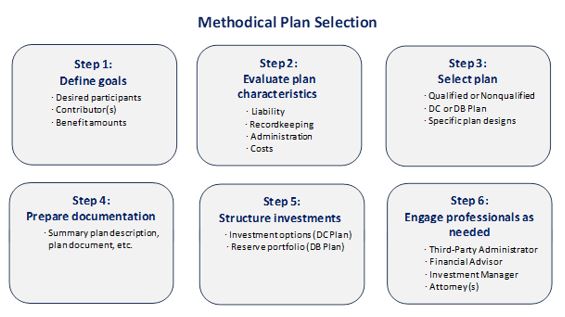

Methodical Retirement Plan Selection

#Finterms: Qualified Plans

Qualified Plans are a category of employer-sponsored retirement plans. They meet specific federal requirements as outlined in the Employee Retirement Income Security Act (ERISA) of 1974. Designs vary in form and function, but all qualified plans share two characteristics. Plan contributions are eligible for immediate tax deductions.

Plan assets grow tax deferred until retirement. Strict rules accompany unique tax benefits. Regulations prescribe eligibility standards, vesting limitations, contribution limits, and required minimum distributions (RMDs). Employers with qualified plans also retain fiduciary liability. Businesses can manage fiduciary responsibilities by hiring specialists, such as Third-Party Administrators and certain Registered Investment Advisors (RIAs).

#retirementplans #ERISA #taxdeferred #qualifiedplan #fiduciary

#Finterms: Registered Investment Advisors (RIAs)

Registered Investment Advisors (RIAs) provide investment guidance to individuals, families, and institutions. RIAs typically collect percentage fees based on their assets under management (AUM). In contrast, other financial institutions (e.g., broker-dealers or “wire houses”) may receive commissions from recommended investments. Some RIAs also provide financial planning guidance for a fixed or hourly rate.

The fiduciary standard further differentiates Registered Investment Advisors from other firms. RIAs have a legal obligation to put client interests first. Care, privacy, and fee-consciousness are central to this duty. Moreover, RIAs generally operate independently and incorporate a variety of investment choices.

Baldwin & Clarke Advisory Services is a Registered Investment Advisor (RIA). Our advisors construct bespoke allocations for each client. Investment management fees are calculated based on the portfolio’s assets under management, and financial planning services are available for a flat fee.

#investments #finance #advisors